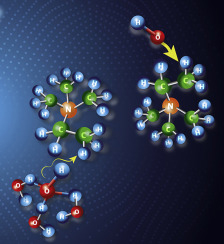
Anion exchange membrane fuel cells can potentially revolutionize energy storage and delivery; however, their commercial development is hampered by a significant technological impedance: the chemical decomposition of the anion exchange membranes during operation. The hydroxide anions, while transported from the cathode to the anode, attack the positively charged functional groups in the polymer membrane, neutralizing it and suppressing its anion-conducting capability. In recent years, several new quaternary ammonium salts have been proposed to address this challenge, but while they perform well in ex-situ chemical studies, their performance is very limited in real fuel cell studies. Here, we use experimental work, corroborated by molecular dynamics modeling to show that water concentration in the environment of the hydroxide anion, as well as temperature, significantly impact its reactivity.